
Before Ronald Reagan saved the free world from Soviet nuclear annihilation, he was a $75-per-week radio announcer recreating Cubs games hundreds of miles from Wrigley Field
For those who grew up in the 1980s and 1990s, Harry Caray was synonymous with the Chicago Cubs. He was the Chicago National League Ballclub’s television voice on the superstation, WGN. But decades before, there was a Cubs announcer who eventually became synonymous with America itself for eight years.
After announcing games for the Cubs, this man became a famous Hollywood actor, then served as Governor of California, and ultimately as President of the United States.
He got into politics early. Elected student body president at Eureka College (Illinois), he played football for the Red Devils and was also a member of the swimming team.
After graduating with the Class of 1932, the Illinois native moved to Iowa and became a radio announcer.
Ronald Reagan’s first stint as an announcer was at WCO in Davenport. He then spent the next four years in Des Moines, where he became the play-by-play man for the Cubs at radio station WHO.
It was a different era. Reagan and others who did “live play-by-play” were doing it remotely—via Morse code.
Reagan described his role:
In the 1930s a team didn’t have its own announcers, and five or six of us did the same game. We kinda competed for the audience. What made it tough is that some of our competitors were doing games live at Wrigley Field while I was in Des Moines, hundreds of miles away.
I was doing the games by telegraphic report. Well, just picture that the fellow sat on the other side of a window with a little slit underneath, the headphones on, getting the Morse Code from the ball park, and he typed out the play. And the paper would come through to me saying something like, “S1C.” That means strike one on the corner. But you’re not going to sell Wheaties yelling “S1C!” So I would say, “So-and-so comes out of the windup, here comes the pitch…and it’s called a strike breaking over the outside corner to a batter that likes the ball a little higher.”
Reagan had to create the game in his own mind and tell the story of the game to his audience—a decidedly different skill than what a play-by-play man does today. All for the princely sum of $75 per week, which was indeed better than his starting rate of $10 per game with WCO.
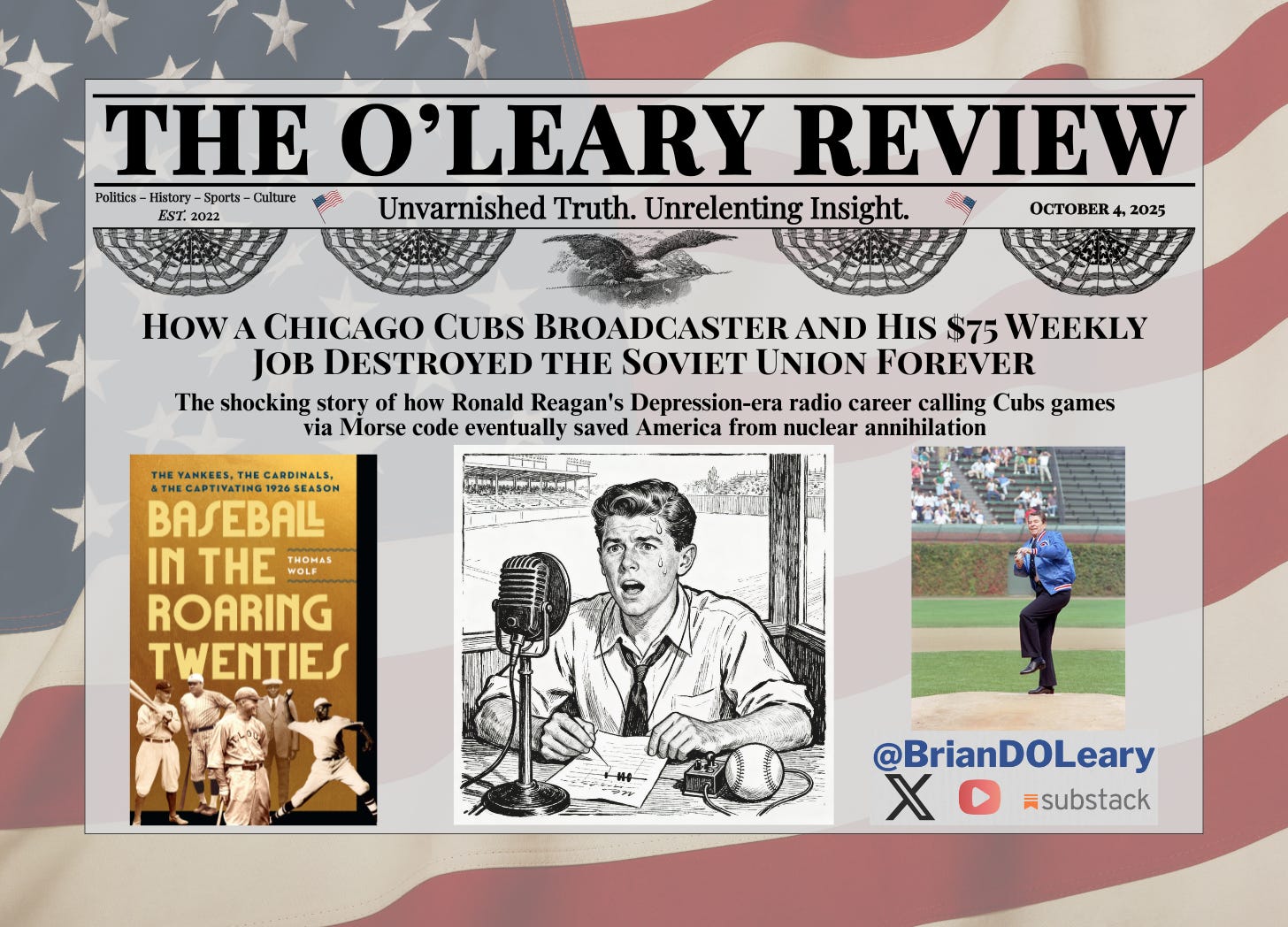
What would a broadcaster do if the Morse code stopped working? In 1934, calling a Cubs-Cardinals game with Dizzy Dean on the mound for the Redbirds, Reagan was handed a note in his broadcast booth.
“The wire has gone dead,” it said. Dutch adjusted.
“There’s one thing that doesn’t get in the score book,” Reagan told a group of Hall of Famers at a White House luncheon in 1981. “So I had Billy [Jurges] foul one off. And I looked at Curly [the fellow on the other side of the booth], and Curly just went like this. So I had him foul another one. And I had him foul one back at third base and described the fight between the two kids that were trying to get the ball. Then I had him foul one that just missed being a home run, about a foot and a half.”
The president then continued his remarks to what he called “the largest assembled group of Hall of Famers that has ever been in one place together at any time.”
“I did set a world record for successive fouls or for someone standing there, except that no one keeps records of that kind. And I was beginning to sweat, when Curly sat up straight and started typing, and he was nodding his head, ‘Yes.’ And the slip came through the window, and I could hardly talk for laughing, because it said, ‘Jurges popped out on the first ball pitch.’”
Broadcasters would re-create games from wire reports well into the 1970s. Once radio voices were employed by a club or by the station with exclusive rights to broadcast the club, it was often too expensive, especially for minor league franchises, to send their broadcasters on the road to experience the action firsthand.
A young Al Michaels famously did re-creations in Honolulu when the Triple-A Hawaii Islanders, for whom he did play-by-play, were on the road—on the continent.
In 1937, “The Gipper” —in something out of the ordinary for most broadcasters at the time—traveled with the Cubs to California for Spring Training. William Wrigley Jr., the Cubs’ owner, also owned Santa Catalina Island, off the coast of California in Los Angeles County. For many years, the Cubs held Spring Training on the island.
Ostensibly, the young broadcaster was going west to familiarize himself with the Cubs ballplayers. But Reagan had a secondary motive.
As fortune would have it, Reagan had some spare time and a desire to ramp up his career in the entertainment industry. He wanted to get into the “pictures.” Reagan broke from Cubs camp for a day or two as he journeyed over to L.A. proper to take a screen test for Warner Bros.
“One day at Catalina, Charlie Grimm, the Cubs’ manager, bawled me out for not even showing up at the practice field,” Reagan recalled. “How could I tell him that somewhere within myself was the knowledge I would no longer be a sports announcer?”
Yet he did return to Des Moines to call more Cubs games remotely. Soon thereafter, however, he found at his apartment—a room within a house on the southeast corner of Fourth and Center—a contract waiting for him in the mailbox.
Warner Bros. had taken a liking to the young radio man. The studio offered him employment as an actor for six months at $200 per week.
So, at the end of May 1937, Reagan left the Hawkeye State behind, moving to Hollywood and eventually parlaying that first contract into a seven-year run with Warner Bros.
The rest is history.
By the end of 1939, the future president had already appeared in 19 films. In a 1952 biopic, Reagan played Hall of Fame pitcher Grover Cleveland Alexander in a role opposite Doris Day in the movie “The Winning Team.” Decades later, as president, Reagan received his costume—an Alexander Cardinals uniform—as a present.
On May 12, 1988, Reagan wrote in his diary: “received a gift the Baseball jersey I wore as Alex the Great in the movie.”
Author Thomas Wolf writes extensively about Alexander in his new book, BASEBALL IN THE ROARING TWENTIES: The Yankees, the Cardinals, and the Captivating 1926 Season (University of Nebraska Press, September 1, 2025).
Wolf recently appeared on the Brian D. O’Leary Show to talk about Alexander—the hero of the 1926 World Series—and much more.
When Rivalries Were Real and Heroes Mattered – The Brian D. O’Leary Show
In Wolf’s book, he delves into the politics surrounding integration in baseball. At one point, before World War I, it looked like integration was on the near horizon. Alas, it would take three more decades for the National and American Leagues to allow black ballplayers in their ranks.
In 1981, President Reagan reflected on that era and his role. “I’m proud that I was one of those in the sports-reporting fraternity who continually editorialized against that rule, that baseball was for Caucasian gentlemen only. And finally, thanks to Branch Rickey and Jackie Robinson, baseball became truly the American sport.”
Later, Reagan would occasionally revisit the press box. On September 30, 1988, Reagan threw out the first pitch at Wrigley Field and then visited legendary Harry Caray in the Cubs booth to call some of the action, live and in person—with no Morse code to deal with.
Reagan told Caray, “You know in a few months I’m going to be out of work and I thought I might as well audition.”
Caray appreciated the president’s chops. “You could tell he was an old radio guy. He never once looked at the television monitor.”
The following season, during the bottom of the first inning of the 1989 All-Star Game, Reagan was again on the call—this time with Vin Scully on NBC’s coverage. The former president chatted with Scully about the American League’s leadoff hitter, Bo Jackson of the Kansas City Royals, and his offseason “hobby” as an utterly dominating running back for the Los Angeles Raiders.
Then Jackson promptly took National League starter Rick Reuschel of the San Francisco Giants deep to center field.
Reagan mentioned to Scully that it was “a bit different” being live at the park versus re-creating the games as he had done in the 30s.
The next batter, future Hall of Famer Wade Boggs of the Boston Red Sox, worked the count and then smashed one over the head of Reds outfielder Eric Davis and into the stands, just like Jackson had done in the previous at-bat.
“Hey, that looks like it’s going there, too. There it is!” exclaimed Reagan.
Later, Regan remarked, “In re-creations and politics, you had to be an actor. How can I not love baseball? It made me what I am today.”
After winning the Wild Card Series over the San Diego Padres earlier this week, the Cubs start the National League Division Series versus the Milwaukee Brewers on Saturday. Reagan will not be on the call, as he has been gone for over two decades now.
Pat Buchanan, former communications director for the Reagan administration, in his immediate reaction upon the news of the death of the 40th President in 2004, noted:
“Well, I was—I’m very saddened by it. I think we’ve lost a good man and a great president.”
It’s interesting to note that there is a good chance that most of us may be dead today if it hadn’t been for baseball. If it weren’t for the circuitous journey in Reagan’s early career, the world may still be on the brink of nuclear annihilation by the Soviet Union.
Thanks to the game of baseball, the rigid beauty of Morse code, and an erstwhile Cubs announcer, there are no such things as “Soviets” any longer.
Good on ya’, Dutch.
Go, Cubs! Go!