
College Football Embraced Them…
Four playoff teams are quarterbacked entirely by transfers—a portrait of how loyalty died in college football’s marketplace.
Jan 06, 2026
During the sweltering late spring and early summer of 1776, the Continental Congress met in Philadelphia to discuss the path forward for the Thirteen Colonies, already over a year into a de facto war with their mother country. On June 11, Congress appointed five patriots to draft a declaration explaining the decision to withdraw from their union with Great Britain.
The three most notable committee members were John Adams of Massachusetts, Benjamin Franklin of Pennsylvania, and Thomas Jefferson of Virginia.
For 17 days, in his free moments away from Congress, Jefferson sat at his desk on the second floor of a three-story rental house on Market Street to compose and edit a short document that codified the Thirteen Colonies’ secession from the British Empire.
In fewer than 1500 words, Jefferson declared that the Colonies intended to become 13 free, independent, and sovereign states, no longer subject to British colonial rule, while also articulating 27 specific grievances that the Colonists could no longer tolerate.
Nearly a century later, Harvard and Yale contested their first intercollegiate football game in November 1875. The first of these contests featured fifteen men per side, and the game more closely resembled today’s soccer—more like an ad hoc playground game from elementary school recess—more than today’s college football. Under a scoring system that also resembled soccer’s, Harvard won the first contest 4–0.
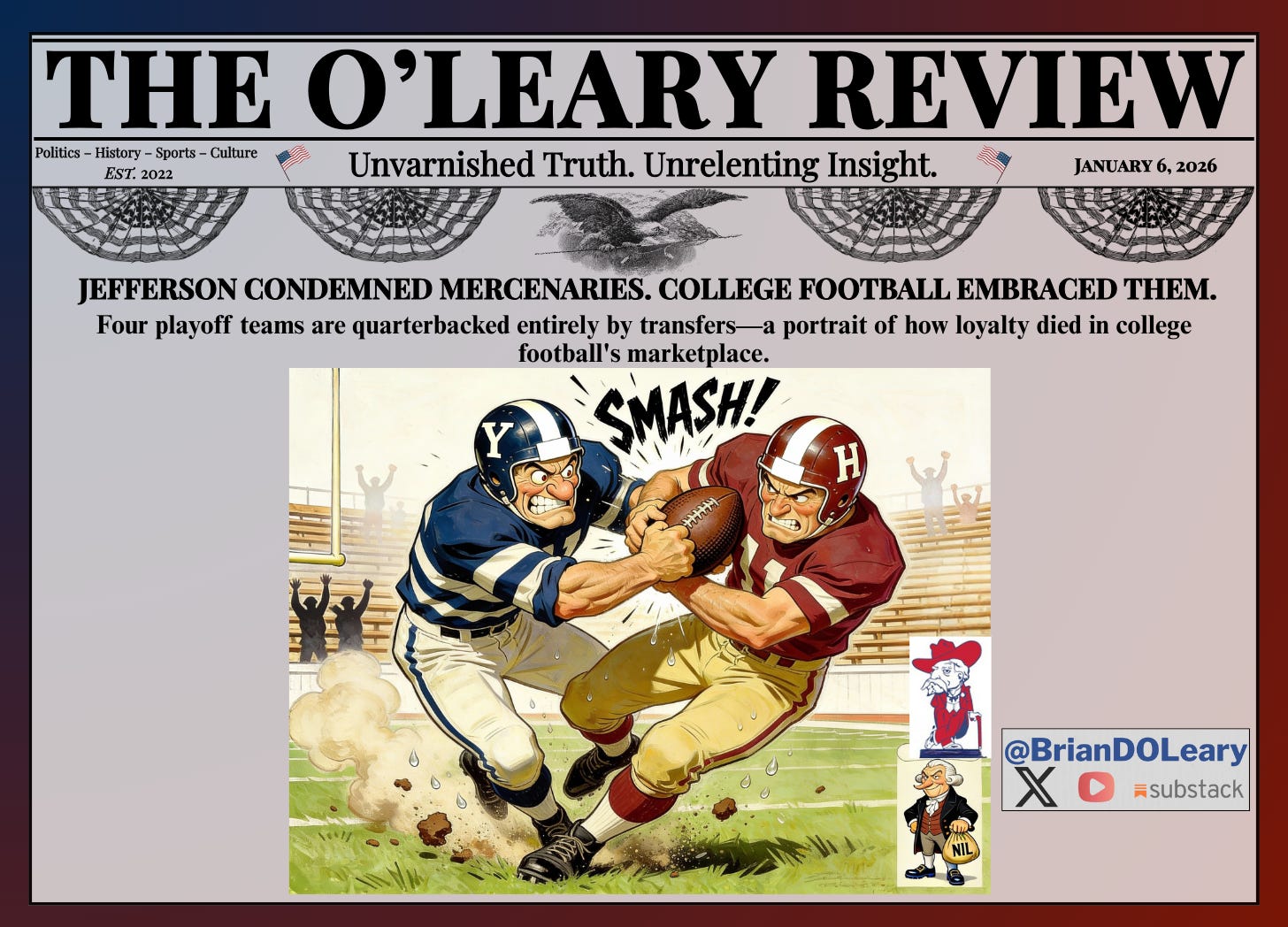
Through 2025, they’ve played 141 times, the third-most games of any college football rivalry, and for a long time, the most important one. For instance, inspired by the two most outstanding programs in the sport, Ole Miss, which fielded its first football team in 1893, chose Yale’s blue and Harvard’s crimson as its team colors.
The wine-and-cheese crowd now calls Harvard-Yale “The Game.” Some even go so far as to believe that it is the last great thing about college football. But let’s not get ahead of ourselves here.
In the 150 years since The Game was first played, college football has undergone a remarkable transformation. As a Harvard freshman, Theodore Roosevelt attended the second Game in 1876. While Roosevelt later trumpeted the “manly virtues” that football taught, the contests that he witnessed in those days bore little resemblance to what we see today.
The line of scrimmage and the system of downs were not instituted until the 1880s. Soon after these implementations, kicking was still so popular that plays featuring the foot often equaled or outnumbered scrimmage plays.
Regarding traditions that no longer exist, a luncheon attended by both teams was typically held before the game. After the game, a fish supper was usually served, and all contestants attended.
Presidents Jefferson and Roosevelt would spit on today’s College Football Playoff. Whereas organized ball sports didn’t exist in the colonial period, the play on the field is altogether unrecognizable from TR’s day.
What would draw Jefferson’s ire, however, is that custom now suggests importing mercenary armies, something the 25th grievance in the Declaration condemned. Armies of athletes chase NIL paydays, stripping programs of loyalty, and turning uniforms into mere rentals.
Consider. Such notions are antithetical to America’s founding ideals.
Jefferson raged against King George’s Hessian mercenaries: “He is at this time transporting large Armies of foreign Mercenaries to complete the works of death, desolation, and tyranny.”
These native Germans with no stake in America fought for coin, not conviction. They hollowed institutions from within, loyal only to the highest bidder. Modern college football mirrors this exactly: players are transported via portal, motivated by booster checks, and emerge disloyal by design.
The 2026 quarterfinal winners—Oregon, Indiana, Miami, Ole Miss—expose the rot. All four starting quarterbacks are transfers: Indiana’s Fernando Mendoza (from Cal), Oregon’s Dante Moore (UCLA), Miami’s Carson Beck (Georgia), and Ole Miss’s Trinidad Chambliss (Ferris State). Across their top 12 skill players (QBs, RBs, WRs), nine are transfers—an infantry composed of 75% mercenary forces.
Even as these teams celebrate, the portal opened on January 2, and they’re already losing pieces while reloading with more imports.
Soldiers of fortune dominate football’s glory, too. Seven of the last 10 Heisman winners were transfers, including the last four in a row (Caleb Williams, Jayden Daniels, Travis Hunter, and Mendoza). Mendoza’s trophy has etched his name at Indiana forever, even if it was built elsewhere.
Yet most of these hired guns will fade into trivia, as the system ensures. “Famous Hessians” is a trivia category only for the nerdiest scholars of the Revolution. Trebek would never…
Meanwhile, fans get a fleeting hero or two. Programs embrace the amnesia.
College football once thrived on roots. Boys from Ohio bled scarlet and gray for generations, while the scarlet and cream were a Nebraskan’s birthright. At the same time, “Civil Wars” in Oregon were an essential part of many a low-grade family feud. Portal mercenaries murder that.
Texas poaches talent nationwide, and, likewise, the nation’s universities poach Texan talent. Alabama finds talent at the auction block, as does Kentucky, Florida, A&M, and every other school with a budget.
Loyalty? Obsolete.
Regional identity? Collateral damage.
The Playoff fuels it. Endless TV money demands wins, the wins demand hires, and the new hires guarantee churn. Even playoff darlings have lost players to the portal as their squads await this weekend’s semifinals. Yet, they reload at the same time, bidding for tomorrow’s Hessians.
It’s not just the players, either. Brian Kelly embodies the coach-mercenary pipeline. He ditched Notre Dame’s tradition for LSU’s NIL war chest—joining the SEC’s open-secret player payments. His $18 million roster flopped: no playoff, a midseason firing, then a $52 million buyout. Notre Dame continued under Marcus Freeman, but without the stench of impropriety that Kelly personified.
Kelly chased the scam, and it devoured him. Now, LSU has turned to Lane Kiffin, no stranger to the sleazy corridors of college football. Here’s a man who turned his back on his team—now standing as one of the final four—to chase the scam as well. Kiffin has perfected what Kelly stumbled through.
Lane reportedly negotiated in his contract with LSU to earn the same bonuses that he would have earned at Ole Miss as the Rebels march through the CFB Playoff. Some of the current Rebels staff—coaching this weekend in the Fiesta Bowl—have already agreed to employment deals and will follow Kiffin to their conference rival.
The tragedy? Nobody remembers these Hessians long-term. Mendoza dazzles now, but in a decade, will Hoosier granddads invoke him as Buckeye fans do with Archie Griffin? Time will tell if Anthony Thompson, the last great Heisman hope for the Hoosiers before Mendoza, is more fondly remembered for his four years of exceptional backfield running in Bloomington than the latest one-and-done transfer from Cal.
Seven transfer Heismans in 10 years means that legends are now rented, not raised. The power brokers at ESPN, the conference offices, and the NIL collectives love it, however. Churn drives ratings, while the NIL cycle attracts clicks across the online media landscape.
Rule tweaks won’t fix what’s broken. The machine prioritizes profit over history and mercenaries over commitment.
What Jefferson and the other Founding Fathers saw in the Hessians was that mercenary armies signal the death of republics. Institutions become so corrupt that they import disloyalty.
College football finally reached that point. Uniforms are rented like hotel rooms, while fans are taxed via tickets and apparel to pay for transient gunslingers.
If they burn the rest of it down? At least the universities could then again build on loyalty, not ledgers.
The open frenzy surrounding the portal underscores the uncomfortable reality facing college football fans today: Even champions reload with foreigners.
Two-and-a-half centuries later, Jefferson’s grievance echoes once again for a reason.
Reflect. Are these the “manly virtues” Roosevelt spoke so emphatically about?