
How Washington’s military ambitions leave Forgotten Americans behind
Many are asking about the recent military intervention into Venezuela to extract its president, his wife, and bring them to “justice” stateside: What kind of precedent does this set?
Great question. However, it is not setting a precedent as much as continuing one. Iraq, Panama, and Cuba come immediately to mind.
A reminder: the Bay of Pigs invasion of Cuba didn’t work out as planned.
One could argue that snatching Saddam and smoking out Noriega achieved their objectives, but where did that leave us? Bogged down. Bloodied. And considerably poorer for the effort.
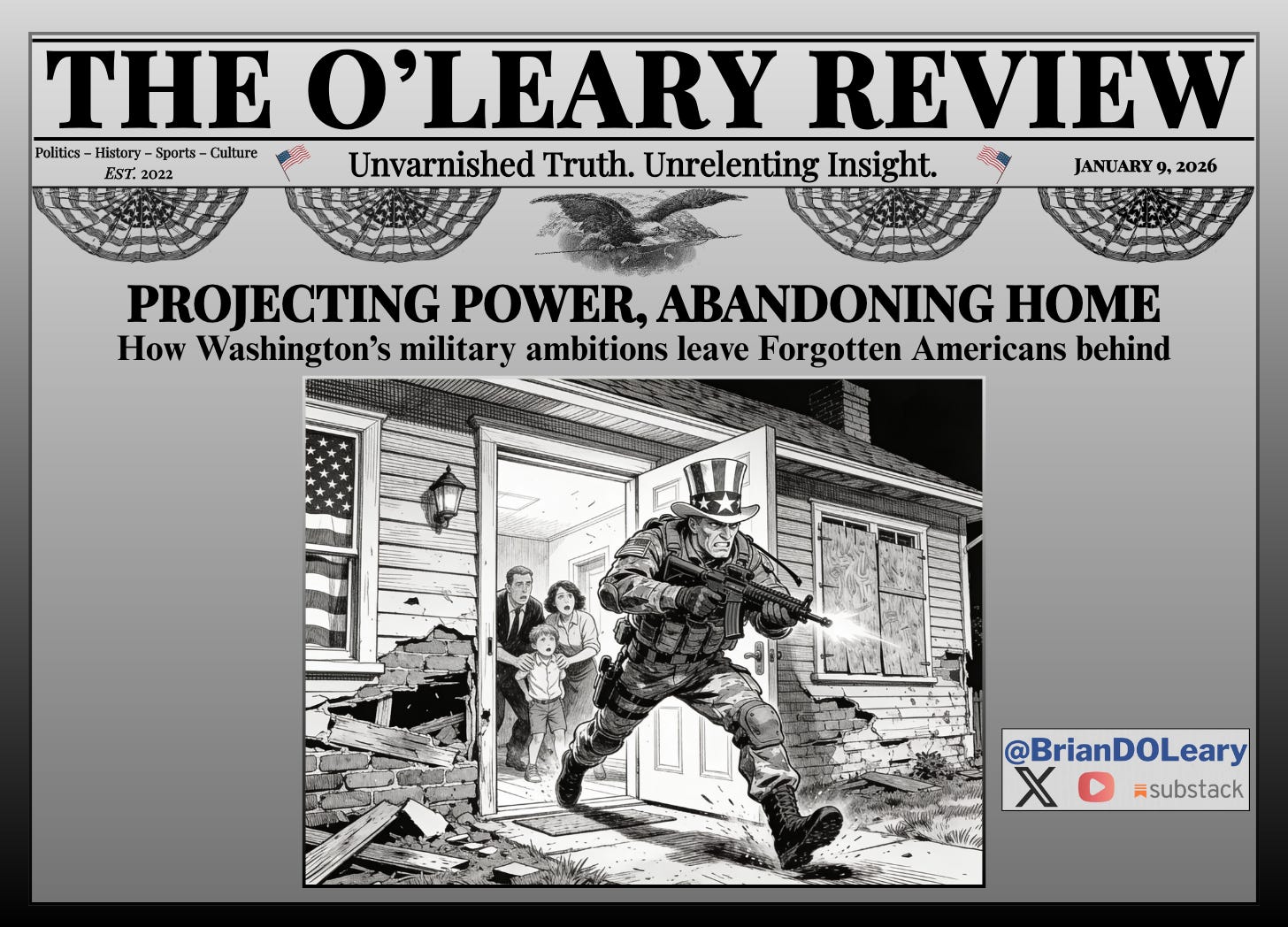
What will happen in Venezuela is largely unknown. Did Trump’s actions lead to a hostile “takeover” of the country, as many in the legacy media have led us to believe?
Yes and no.
Once more, it continues the legacy of the U.S. regime—installing a new puppet regime, in other words. The machinery of American foreign policy has been reactivated, and the gears are churning in Caracas just as they did in Baghdad and Panama City decades earlier.
Trump did set a new precedent, however, and it is one worth examining closely. This time, his actions were brazen.
The various government agencies—the CIA, State Department, and the oxymoronic reality of Defense Intelligence—acting in concert with the military-industrial complex, have operated in the shadows for generations. They preferred the deniable coup, the proxy war, the quiet removal of inconvenient strongmen.
Trump has made it public. The dog-and-pony show that once played behind closed doors now unfolds on cable news and social media in real time.
This is, in many ways, more honest. It is also, arguably, more dangerous. When empire operates in shadows, there remains a veneer of propriety, a thin democratic fiction that the American people maintain some control over their government’s actions.
When Trump broadcasts his intentions like a real estate mogul hawking a Miami condo, that fiction evaporates. Americans are left staring at the naked architecture of imperial ambition.
Will there be regime change in Venezuela, Cuba, Colombia, Greenland, or any of the other places we’re hearing that Trump is “targeting?” For what is Trump’s motivation?
If one is into reading tea leaves, there is an attempt at legacy-building here. Trump wants to be remembered as the president who restored American strength, who didn’t tolerate adversaries in the Western Hemisphere, who seized the historical moment and wielded American power decisively.
That’s the narrative.
None of these expeditions should turn into another quagmire like Iraq or Afghanistan, even Vietnam. But that’s what everyone says before they commit the troopers. The dream is always surgical excision of a cancerous polity within “our” sphere of influence. The reality, as history shows, is far messier.
Comes the reply from the forgotten Americans on the West Coast: Can we, first, please, get regime change here in California or Oregon?
Governors Newsom and Kotek are arguably worse for humanity than Maduro or the extended Castro family. Certainly, worse for Americans who are currently under their thumb. This is not mere partisan hyperbole—it is the exasperated cry of citizens watching their own states collapse under progressive mismanagement while Washington tilts at windmills abroad.
Jack Callahan reports this time on his wife’s analysis. Mrs. C was a philosophy and mathematics double major in college. “The missus has good reason to think that Trump’s policy is to triangulate those lower Caribbean targets like Venezuela and Colombia with our old, cantankerous neighbor, Cuba. The third point on that triangle is Greenland. I think she’s on to something.”
It’s a neat geopolitical theory, and like most such theories, it may or may not survive contact with reality. What matters more is what comes after—the occupation, the administration, the endless commitment of blood and treasure.
Sarah Callahan is not keen on invasion, however. She’s seen the aftermath with “refugees” from Afghanistan sucking up vital resources in a diverse array of American cities and towns. She understands that military adventures abroad inevitably lead to humanitarian catastrophes that reach American doorsteps.
And she’s watched as her own country—Oregon, an alleged beacon of progressive enlightenment—has become something unrecognizable through the incompetence of those supposedly governing it.
Not only have bandits from Somalia relocated writ large from the Horn of Africa to Minnesota’s Twin Cities, but in the Callahan’s home state, Kayse Jama—the Mogadishu-bred community organizer and admitted “Son of a Camel Herder” —stands as the current Majority Leader of the Oregon State Senate. This alone tells you something about the priorities of contemporary American governance.
Mrs. Callahan puts it bluntly: “There are too many people in the United States as it is. We need to take care of the people who are already here. I don’t care who they are or where they come from. They’re our citizens. We cannot, however, admit more and more new people. It’s not in the budget!”
This is not xenophobia. This is arithmetic. It is also the voice of someone who understands that government resources are finite and that every dollar spent on housing and feeding newcomers is a dollar not spent on American citizens already struggling. She also grasps that there is something fundamentally obscene about undertaking these overseas military adventures as our own cities crumble.
On Thursday, Jama addressed ICE and all the federal agencies in broken English, “This is Oregon. We do not need you. You are not welcome. Get the hell out of our community.”
Ironically, he/him spoke in the aftermath of a Venezuelan Tren de Aragua gang member’s attempt to run over a border patrol officer on the eastside of Portland. ICE agents reportedly shot two gang members because of this encounter. Such is the give-and-take that accompanies crime when there is an effective law enforcement mechanism, which Portland and Oregon’s political leaders have successfully eliminated.
On hearing the news, Jack relayed what Mrs. Callahan told him, “Nothing good happens out there ‘in the numbers’ anymore.”
The inner-city problems of the old society have been displaced to the “zones of transition” —the inner and middle rings of cities, suburbs, and small towns, where working families once thought they could escape the chaos.
No longer. Crime has taken over.
Consider the words of Senator Rand Paul (R-KY) on Thursday’s Bannon’s War Room. To paraphrase: I’m supporting new legislation that makes it explicit that if you defraud the government, you can be deported. I don’t really care to pay for Somali fraudsters’ food and lodging in a U.S. prison. They should be sent back.
Sent back. This is common sense speaking truth to bureaucratic absurdity.
Consider. Why should American taxpayers bear the cost of incarcerating foreign nationals who have defrauded the system?
The answer? They shouldn’t.
Note that Americans, including Mr. and Mrs. Callahan, prefer and are more comfortable with the herding of sheep and cattle than East African camels. This is not a cultural slur, but an observation rooted in experience. Americans built a civilization around pastoral agriculture, property rights, and land stewardship.
They understand order, hierarchy, and discipline, the things required to manage a flock or herd successfully.
Jama and his Democratic compatriots have proven no good at herding anything, try as they may in their case, with proverbial cats. Yet a cat-herding expert is necessary.
Could Trump be such a buckaroo?
Perhaps. But first, America must decide what it is.
Is it a nation committed to order and coherence, to the preservation of its own people and their way of life? Or is it an empire so consumed with projecting power abroad that it cannot manage the chaos at home?
The answer to that question will determine whether regime change in Venezuela matters at all.