
The “dragonslayer” of the hardwood
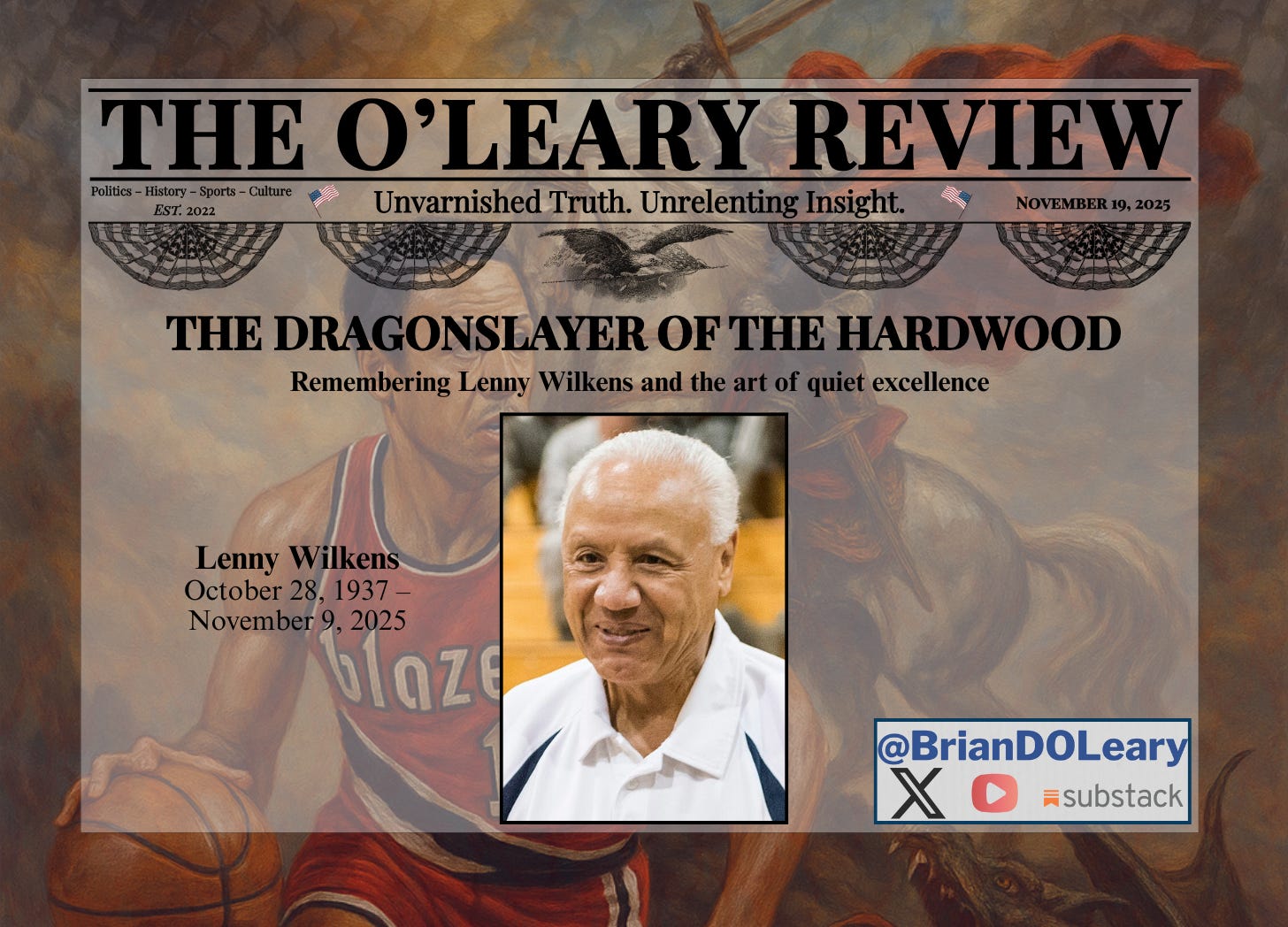
Basketball Hall of Famer Lenny Wilkens passed away on November 9, 2025, at the age of 88. We’ve written about Wilkens a few times here at The O’Leary Review. What follows is a newer draft of a column originally published earlier this year.
May 25, 2025
In an age where spectacle passes for achievement and self-promotion masquerades as leadership, the story of Leonard Randolph Wilkens—Hall of Fame player, coach, and reluctant icon—reads like a countercultural manifesto.
His career spanned the eras from the untelevised grind of 1960s NBA arenas to the social media cacophony of modern sports. Yet the true legacy of Lenny Wilkens lies not in his statistical milestones or championship pedigree, but in his lifelong resistance to the “dragon” of performative success.
This is not merely a basketball story. It is an exploration of how wisdom, cultivated in the unlit corners of Brooklyn playgrounds and Providence College gyms, can outmaneuver both institutional prejudice and the seductive rot of modern celebrity.
At its heart stands an unlikely pairing: a mixed-race prodigy from Bed-Stuy and a French professor-turned-mentor who loved opera more than jump shots.
Born in 1937 to a black father and an Irish-American mother, Wilkens inherited a world of contradictions. His father’s death when Lenny was five thrust the boy into a role no child should shoulder.
“You’re the man of the family now,” an aunt declared at the funeral, a decree that sent him delivering groceries through Brooklyn streets at age seven.
His customers included Jackie Robinson, whose quiet dignity under racist taunts became Lenny’s blueprint for navigating a nation still two decades away from meaningful civil rights legislation.
I was pretty stunned. But Jackie was great. He immediately thanked me for the groceries, then sat me down and asked if I ever got a chance to go to Dodger games. I told him that my brother and I would save up our money and when we had enough, we’d go sit in the bleachers. I’m sure that Jackie knew that every kid in Brooklyn did the same thing, but he took the time to sit down and listen to me—and by doing so made me feel important and became my role model.
I saw the harsh way he was treated on the field, yet he never complained. So when things went wrong for me or I was mistreated, I’d tell myself that if Jackie didn’t complain about his situation, then I certainly couldn’t complain about mine.
The basketball courts of Bedford-Stuyvesant served as both escape and classroom. Here, Wilkens developed a style antithetical to playground lore—a left-handed guard who prioritized court geometry over flashy crossovers.
“The playgrounds I knew were tremendous training grounds,” he’d later reflect. “Today being a playground player is an insult. It means all you want to do is go one-on-one.” This rejection of individualism, forged in the crucible of 1950s New York, would define his career.
At Providence College, Wilkens found more than a basketball scholarship. He discovered Fr. Raymond B. St. George, a French professor and band director. In 1990, he was inducted into the Providence Hall of Fame for his time as a Friar baseball player. Though in the 1950s, St. George also served as the athletic department moderator and NCAA liaison.
To the casual observer, Fr. St. George was merely another academic administrator. To Wilkens, he became the first person to treat basketball as intellectual architecture rather than brute spectacle.
The influence of St. George manifested in subtle strokes. As Wilkens later recounted, the priest would linger at practices not to critique plays, but to ask questions: Why that pass? What did you see? How does the defense’s rotation dictate spacing?
These Socratic dialogues transformed the game into a chess match, with Wilkens as grandmaster-in-training.
The results were immediate. Wilkens earned two All-American honors and the NIT MVP award. For Providence, it was their first time with any real relevance. They were under the national spotlight for once.
Yet the lessons Fr. St. George imparted to young Wilkens transcended basketball. When Wilkens faced a career-defining choice in 1960—teach economics at Providence, join the industrial AAU league, or gamble on the fledgling NBA—the priest counseled discernment.
“He made me list the intangible costs,” Wilkens recalled. “Not just salaries, but what each path would demand of my character.” His decision to negotiate a $1,500 signing bonus from the St. Louis Hawks (matching AAU pay) reflected this analytical rigor and marked the NBA’s first flicker of modern contract bargaining.
Though he ultimately did not go down that road, applying for the teaching position at Providence also troubled Wilkens. On the application, there were boxes for “race: “Negro” or “Caucasian.” His late father was a black American, while his mother was an Irish American Catholic. He didn’t want to deny either side of his heritage by checking either box.
He decided to cross out both options and create a new box. He labeled it and checked it. “African American.”
It wouldn’t be for a couple more decades until the general public started using this term.
Fr. St. George’s love of opera eventually rubbed off on Wilkens. Early in his rookie season, Lenny took over as the Hawks’ starting point guard, but before home games, and to the astonishment of his new teammates, he would often sneak away to the opera house next to St. Louis Kiel Auditorium.
But the 15-year playing career (1959-1975) that Wilkens embarked upon unfolded like a jazz improvisation on Fr. St. George’s classical themes. Nine All-Star appearances and second all-time in assists upon retirement. The 1971 All-Star Game MVP.
But the most revolutionary act from Lenny Wilkens may have come in 1969, when the Seattle SuperSonics named him player-coach, a role requiring the diplomatic precision of a UN envoy.
The NBA had seen player-coaches before, but none that navigated the dual realities Wilkens faced: a black man strategizing against veteran NBA coaches while managing white teammates accustomed to segregated locker rooms. His solution was characteristically understated.
“I led by respecting their professionalism,” he said. “If I diagrammed a play, it wasn’t because I was the coach—it was because the play made sense.” This quiet authority propelled Seattle from 30 wins in 1968-69 to a franchise-first .500 record by 1971-72.
Upon retiring as a player in 1975, Wilkens faced a league increasingly infatuated with cults of personality. Fellow player-turned-coach, Don Nelson, would soon pioneer the small-ball antics that became known as “Nellie Ball.” Pat Riley eventually perfected his Armani-clad sideline theatrics and “Showtime.”
Meanwhile, Wilkens—now coaching full-time—doubled down on substance. His 1979 SuperSonics championship team embodied this philosophy. They had no scorers among the league’s top-10, but the Sonics did have five players who averaged between 13 and 19 points.
“Balance isn’t a tactic,” Wilkens insisted. “It’s a worldview.”
The numbers vindicated his approach. Wilkens passed Red Auerbach’s then-record of 938 coaching wins in 1995, eventually compiling a .536 winning percentage across 32 seasons and six franchises. His 1,332 career victories stood as the NBA record until 2010.
Yet these milestones obscure his greater triumph: proving that black coaches could sustain excellence without conforming to the expectations of white owners, either through militancy or subservience.
Modern analytics obsess over Wilkens’ statistical footprints. He now sits at third in coaching wins and ninth in player assists. More revealing are the absences: zero technical fouls for berating officials, no endorsements peddling sneakers or soft drinks, and no reality TV cameos.
His post-retirement work with the Odessa Brown Children’s Clinic, raising $7.5 million for Seattle’s underserved, reflects priorities forged long before Instagram activism.
Fr. St. George’s influence echoes here. Just as the priest used NCAA oversight to protect student-athletes from academic exploitation, Wilkens leveraged his fame to empower others.
“Celebrity is currency,” he told the Seattle Times in 1996. “Spend it on those who’ll never get a jersey retired.”
In 2021, the NBA’s 75th Anniversary Team named Wilkens among its 75 greatest players and 15 greatest coaches, and still the only dual honoree.
Meanwhile, he has been inducted into the Naismith National Baseball Hall of Fame three times—as a player, a coach, and as a member (assistant coach) of the 1992 Olympic “Dream Team.” For good measure, he was also inducted into the College Basketball Hall of Fame in 2006.
All the recognition may be bittersweet now in an era where load management supersedes durability and TikTok highlights outweigh fundamental mastery.
The career of Lenny Wilkens whispers an urgent truth: Sustainable success requires resisting the twin sirens of grievance and grandstanding.
From his mother’s Catholic stoicism to Fr. St. George’s intellectual rigor to Robinson’s silent resilience, he assembled an anti-fame blueprint. The ideas of preparation over promotion, equity over ego, and quiet impact over viral moments are increasingly alien in our age of manufactured outrage.
As we navigate cultural landscapes obsessed with branding every hardship and monetizing every principle, the example of Lenny Wilkens looms as both rebuke and roadmap. The dragons he slew—racism, poverty, mediocrity—were real.
That he did so without fanfare, treating excellence as its own reward, may be his most enduring assist.
Put on your calendar next April 23 for the feast day of George of Lydda—the original St. George and the namesake of the mentor of the great Lenny Wilkens—who was martyred in the Diocletian persecutions for refusing to recant his Catholic faith.
St. George has been widely venerated as a saint amongst military personnel since the Crusades, and legend has it that he also killed a real dragon.
If you have a Substack or want to get started on that platform, I just put together a 31-page guide to help you do it. Properly. It’s called Your Substack Success Blueprint.
And since we talk about Magic Johnson (and all things Lakers) in our latest podcast…
When Myths Collide: A Hollywood Tragedy in Two Acts
So, to pay homage to one of the game’s true greats, the first 32 people to buy Your Substack Success Blueprint will get a sweet $32 discount.
Use code SUBSTACK at checkout. The deal expires after the first 32 purchases or at the end of the calendar year, whichever comes first.
Larry asks, “Magic today?”
“Yeah, Kareem’s in the wash.”
For press, sponsorship, or guest inquiries, you can reply directly to our emails. I read all the responses.