How 2020’s Great Betrayal liquidated our cultural inheritance, and why localism is the cure.
Six minutes and forty-one seconds.
That is the exact duration of college basketball I consumed this season. I turned on the television during the dying moments of the national championship game. I sat in my living room, watching the final possessions unfold, waiting for the familiar adrenaline rush to return.
It never arrived.
The screen flickered with what was supposed to be the pinnacle of athletic competition, but all I saw was a hollow corporate spectacle—and bad basketball.
There was a time when this meant everything. I remember a Monday night in 1985 when I dragged my father and my brother to Civic Stadium for a Portland Breakers USFL game (as well as an eight-year-old could). I got tickets for my birthday, and this was the only time I ever saw my hometown pro football team in person.
As I sat in the stands of a sparsely populated stadium on my birthday, I watched the Breakers and the Gunslingers intently. My dad, however, largely ignored the football action in front of us. Instead, he strained to hear the crackling broadcast of Villanova dismantling Georgetown on a stranger’s boombox.
I remember the golden era of Big Monday. I remember Jerome Lane obliterating the backboard with a savage dunk, and Bill Raftery losing his mind on the call. “Send it in, Jerome!”
The grit, the intensity, the unvarnished reality of it all—it belonged to us. It was a shared cultural inheritance.
That inheritance has been liquidated.
The Great Betrayal commenced in the spring of 2020. Soon thereafter, the American public desperately needed an escape from the crushing weight of Faucian grandiosity, but the sports monopolies folded without a fight.
The Masters, historically a stronghold of unapologetic tradition, canceled their spring tournament. Every other league abandoned the playing fields, with the isolated exceptions of a cornhole tournament on ESPN and a rain-soaked “The Match” golf exhibition. They surrendered their dignity to the safety theater of a manufactured panic over a respiratory virus.
People lost their businesses. Draconian edicts tore families apart. The working class watched their livelihoods evaporate.
And what did the billionaire sports owners and millionaire athletes do? They demanded absolute compliance. They lectured the populace from their gated compounds. They treated their most fiercely loyal patrons with dripping contempt.
No executive or commissioner has ever issued an apology for their cowardice. They expect us to forget the indignity.
The fans and the franchises used to have an unwritten social contract. We gave them our hard-earned money, we’d read the newspaper, tune in to ESPN and sports radio, and, most importantly, give them our generational devotion. In return, they provided a reliable product that we saw as a benchmark of excellence.
That contract was torn to shreds.
The post-corona sporting regime no longer views the fan as a partner in a shared cultural and civic experience, but as a captive revenue stream to be exploited and mocked. One must wonder what its real motivation was before the corona-panic.
They changed the collegiate eligibility rules and have turned amateur athletics into a chaotic, soulless bidding war. They transformed stadia into sterile luxury lounges for the corporate elite, pricing the working-class family out of the building entirely.
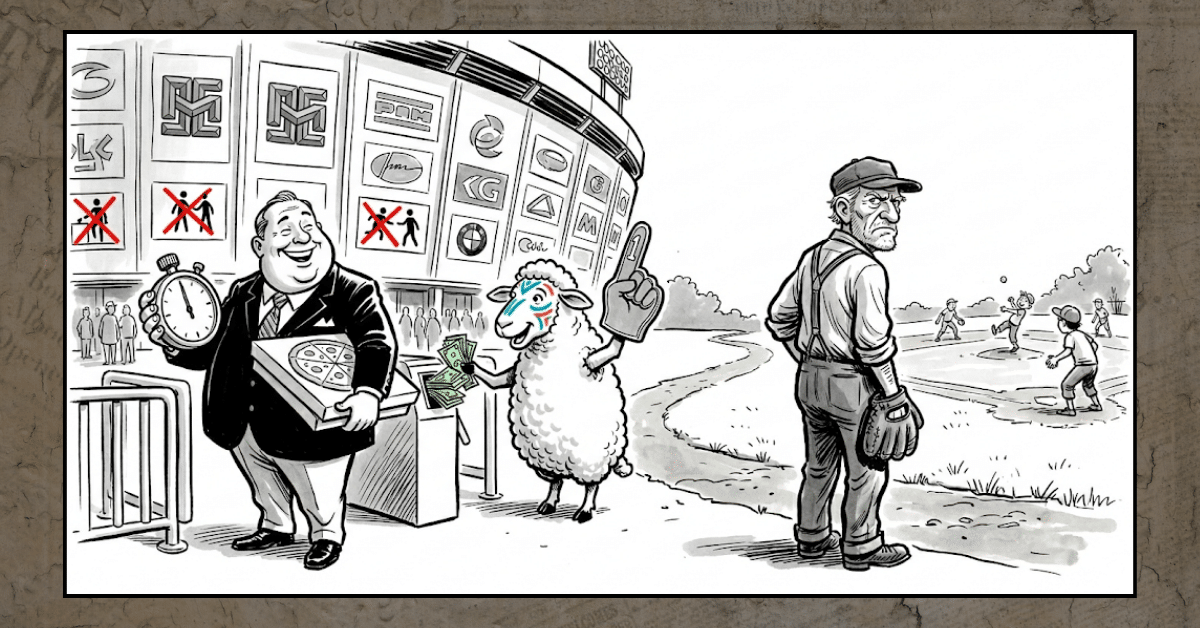
Now, these same institutions expect us to return to the turnstiles, wallets open, to consume a fundamentally degraded product. Look at the abomination they have made of Major League Baseball. Technocrats have aggressively butchered the timeless, pastoral rhythm of the diamond.
My old friend Jack Callahan summed it up perfectly last summer while watching a nationally televised broadcast. “They put a stopwatch on the pitcher to rush the game,” Jack growled, pointing a thick finger at the screen. “They bolted oversized pizza boxes to the infield to artificially inflate stolen bases, and they told pitchers they can only throw over to first base twice. They mutilated the national pastime to hold the attention of teenagers who cannot stop staring at their phones for five consecutive minutes.”
Jack is entirely correct. The league is chasing the lowest common denominator, stripping the game of its strategic soul to appease a transient, distracted mob.
Herein lies the profound paradox of our modern sports era. As the product becomes increasingly sterile, the modern sports consumer becomes increasingly tribal. Men paint their faces and scream themselves hoarse for a collection of athletic mercenaries who harbor absolute disdain for them.
The mob happily returns to the stadiums, paying exorbitant sums to the precise corporate entities that abandoned them at the first sign of cultural friction. They pledge unyielding loyalty to leagues that possess no loyalty to them. It is a pathetic display of collective surrender.
I refuse to participate. As late as 2020, I held Division I basketball and baseball season tickets and, admittedly, was an active participant in the spectacle.
Today? I will not buy a ticket to a professional game. I will not fund the vanguard of our cultural rot. We cannot control the fact that the corporate coliseum has been corrupted. But we can control where we direct our loyalty, our money, and our time.
The solution is not to sit on the couch and lament the death of the old days. The solution is immediate, unapologetic localism. Cut the cord. Starve the beast.
If you miss the purity of competition, walk down to the local municipal park. Watch the high school kids play under the Friday night lights. Volunteer to coach a youth team. Impart the rigorous strategic wisdom of the game to a generation that desperately needs discipline. Teach them the psychological warfare of the pickoff move.
Show them how the game was played before the technocrats broke it. Show them what it means to stand your ground.
You cannot force the NCAA to care about its heritage. You cannot shame the elites into apologizing for their surrender. But you can build your own permanent things. You can foster excellence within the walls of your own home and the borders of your own town. The national sports machine is dead to us.
Let the rabble have it. We have a culture to rebuild from the ground up.
© 2026 by Brian D. O’Leary. All rights reserved.