
The Portland I Left Behind, The Healthcare Debate That Never Ended
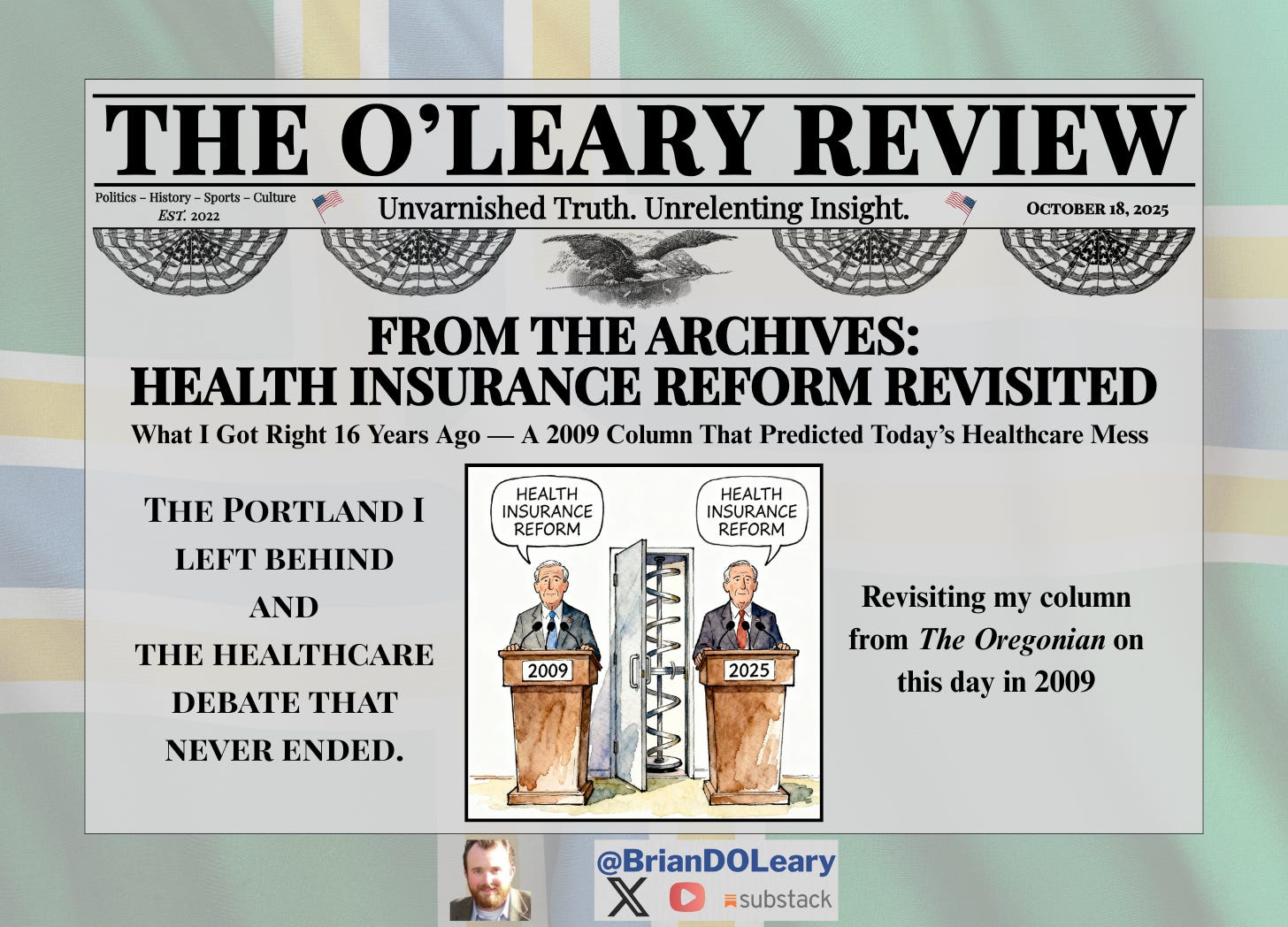
Republishing My 2009 Oregonian Column
I was digging through my archives earlier today, and to my surprise, I came across the column that follows this introduction. Sixteen years ago today, The Oregonian published my guest column on healthcare reform. I lived in Portland then. It is my hometown and a city I both loved and understood.
As is my practice, I wrote with confidence about what America needed, convinced that the solution was more straightforward than Washington was making it out to be.
I had no idea that within months, the so-called Affordable Care Act (ACA) would reshape the entire landscape I’d been analyzing, nor could I have imagined how profoundly both my city and our national healthcare conversation would transform in the years to come.
Rereading this column in 2025 is like opening a time capsule from another world.
Thanks for reading The O’Leary Review. Please share within your circle and challenge them to think deeper than clickbait.
The Portland where I wrote these words has changed in ways that were unthinkable in 2009. The already dire homelessness crisis has exploded, both in sheer numbers and in the lawlessness surrounding the issue. The homicide rate has nearly quadrupled from 21 in 2009 to 77 in 2023. This does not account for scores of “missing persons” or the unknown and unprosecuted murders within homeless encampments.
Downtown businesses that survived the Great Recession have boarded up their windows. The quirky, creative community I knew has mainly been priced out, replaced by condos and more transplants. Yet, for that Portlandia-type crowd, I don’t shed too many tears.
In 2022, Portland voters approved a complete overhaul of the city’s government structure, implementing ranked-choice voting and expanding the city council from five to twelve members—a testament to how broken the old system had become.
The system in place now, however, is even worse for Portlanders. Bureaucratic grift—ever-present in the Rose City since its inception—is as naked as the ludicrous bike rides that occur in Portland with stunning regularity.
I no longer live in Portland, and I haven’t for almost a decade now. The city I wrote about in 2009 exists only in memory.
Furthermore, in Portland, free speech exists only in fantasy. Politicians relentlessly gaslight the public about the reality on the ground. Local news channels are beholden to a similar left-wing ideology that empowers the dominant political flavor. For instance, The Oregonian’s ?–Twitter account blocked me years ago—as it has with many others who expressed opinions to the right of Mikhail Gorbachev.
The healthcare debate, meanwhile, followed its own trajectory. A month after my column appeared, the machinery that eventually produced the Affordable Care Act was already grinding forward. By March 2010, President Obama had signed the legislation that Republicans spent the next fifteen years trying to repeal.
The ACA did accomplish significant expansions in coverage—marketplace enrollment reached 24.3 million in 2025, more than double the 11.4 million enrolled in 2020. Yet the fundamental tension I identified in 2009 remains unresolved: we still conflate health insurance with healthcare, and Washington still treats reform as an opportunity for political grandstanding rather than pragmatic problem-solving.
What strikes me most about this column isn’t what I got wrong—the passage of the ACA proved that my call “to scrap the whole debate right now” was hopelessly naive. Instead, it’s how the core argument holds up.
I wrote that “the issue really is who is going to pay for it all,” and that remains the central question today, as enhanced ACA subsidies expire at year’s end, threatening to increase premiums by an average of 114% for those receiving financial assistance.
I argued for turning health insurance “back into insuring our health,” rather than prepaid, so-called healthcare—essentially advocating for what we’d now call catastrophic coverage paired with Health Savings Accounts. That idea lost decisively in 2010, but the ongoing debates over premium tax credits and Medicaid expansion show we’re still wrestling with the same fundamental questions about the proper role of insurance versus comprehensive coverage.
The America of October 2009 was emerging from the 2008 recession and had elected its first black president, believing that major policy reforms could still achieve bipartisan support. That optimism appears quaint now.
The Portland where I wrote this column was cleaner, safer, and more affordable than it is today. And the healthcare debate that I believed was too simple for Washington to complicate has only grown more Byzantine with each passing year.
I’m republishing this column not because I think it contains all the answers—I was in my early 30s and probably more certain than I should have been about anything. But because sometimes it’s valuable to remember what the questions looked like before they were answered, to see what we were worried about before we knew what would happen. The ACA has been the law of the land for fifteen years now.
Whether it solved the problems I identified, created new ones, or reshuffled the deck is for the reader to judge.
What is certain is this: both my hometown and my country’s healthcare system have changed beyond recognition since I wrote these words.
And yet, somehow, the essential arguments remain maddeningly familiar.
– BO’L
The column:
It’s health insurance, not health care, that demands reform
By Brian O’Leary
Guest Columnist | The Oregonian
October 18, 2009
I am close to giving up on the health care debate. It seems rather simple to me, but the Washington pols make it complicated and, in turn, grandstand in an attempt to show the American public how important they are. The attempt is pathetic.
Whether reform is what we need or not seems not to be important for the power-hungry in Congress.
Those on the left say we need reform, but only in the model they want to foist upon us.
Those on the right talk about the lack of need for reform of any type and cite statistics about how most Americans are happy with their health care and how any reform would transmute into rampant socialism.
Neither approach is wise, nor does either show leadership when it should count.
We need some sort of reform in this arena, no question, but it is not as if Americans (and even non-Americans alike) cannot now or will not in the future get proper health care. The issue really is who is going to pay for it all.
The first tact should be health insurance reform, not health care reform. America is the standard-bearer for nearly everything medical, and people flock here from all over the globe. But if one wants the best, one should be paying for the best.
As for reform of health insurance, we need to return it to what it is…insurance. What we have in most cases now passing as health insurance is a bungled mess of pre-paid health care passing itself off as true insurance. Use it or lose it, they say.
A “public option” would simply make the whole process even more bungled and therefore more expensive. Health Savings Accounts are a step in the right direction, but they don’t go far enough. Money expires! Use it or lose it again. Ridiculous.
One thing the government can do, instead of trying to get all the dollars coming its way and redistribute them—with its omnipresent brokerage fee—is to open up insurance markets. Put an end to the de facto pre-packaged health care monopolies that exist in each state. Let people shop around for health insurance. Don’t pigeonhole people into buying coverage that is not in their interests.
Doctors will still care for people. Hospitals will still care for the sick. Grandma’s plug will not be unnecessarily pulled.
Simply, insuring people properly is what needs to be done. Maybe that will be more expensive—short-term, long-term or both—but it will get money into the hands of people who can make that decision, not wasted upon politicos and bureaucrats that are in no position to make such decisions in the first place.
Folks who think that government taking a larger role in the nation’s healthcare will make it more expensive are probably right, but once again, that is not the issue. We do have to pay for what gets done, but nobody—government in this instance—should not be taking money where either no work or substandard work is done.
It would be best to scrap the whole debate right now. The time spent on it is already a sunken cost.
Let’s start again by doing what is needed and what is most pragmatic by turning the concept of health insurance back into insuring our health.
Brian O’Leary lives in Portland.
Guest Columnist