
Jack Callahan examines how a failed biotech CEO now lectures patriots about what makes America real.
Jack Callahan was nursing a coffee at his kitchen table when the transcript from Phoenix landed in his inbox. Vivek Ramaswamy’s AmericaFest speech—the one where Ohio’s Republican candidate for governor decided to lecture conservatives about what it means to be American—had him shaking his head.
“This kid, this Padawan of Davos, stands up in front of tens of thousands of young conservatives and tells them that the idea of a ‘heritage American’ is ‘as loony as anything the woke left has put up,’” Jack said over a Zoom call, sliding his reading glasses down his nose. “Is that about right?”
It was.
“Son,” Jack continued, “I’ve traced my line back to an ancestor who bled for General Washington in the Jersey campaign. Another signed a petition against the Stamp Acts. What about you, Brian? What’s your lineage?”
At least twelve ancestors who fought on the Colonial side in the Revolution. Documented. Verifiable. The full weight of centuries of American blood and sacrifice.
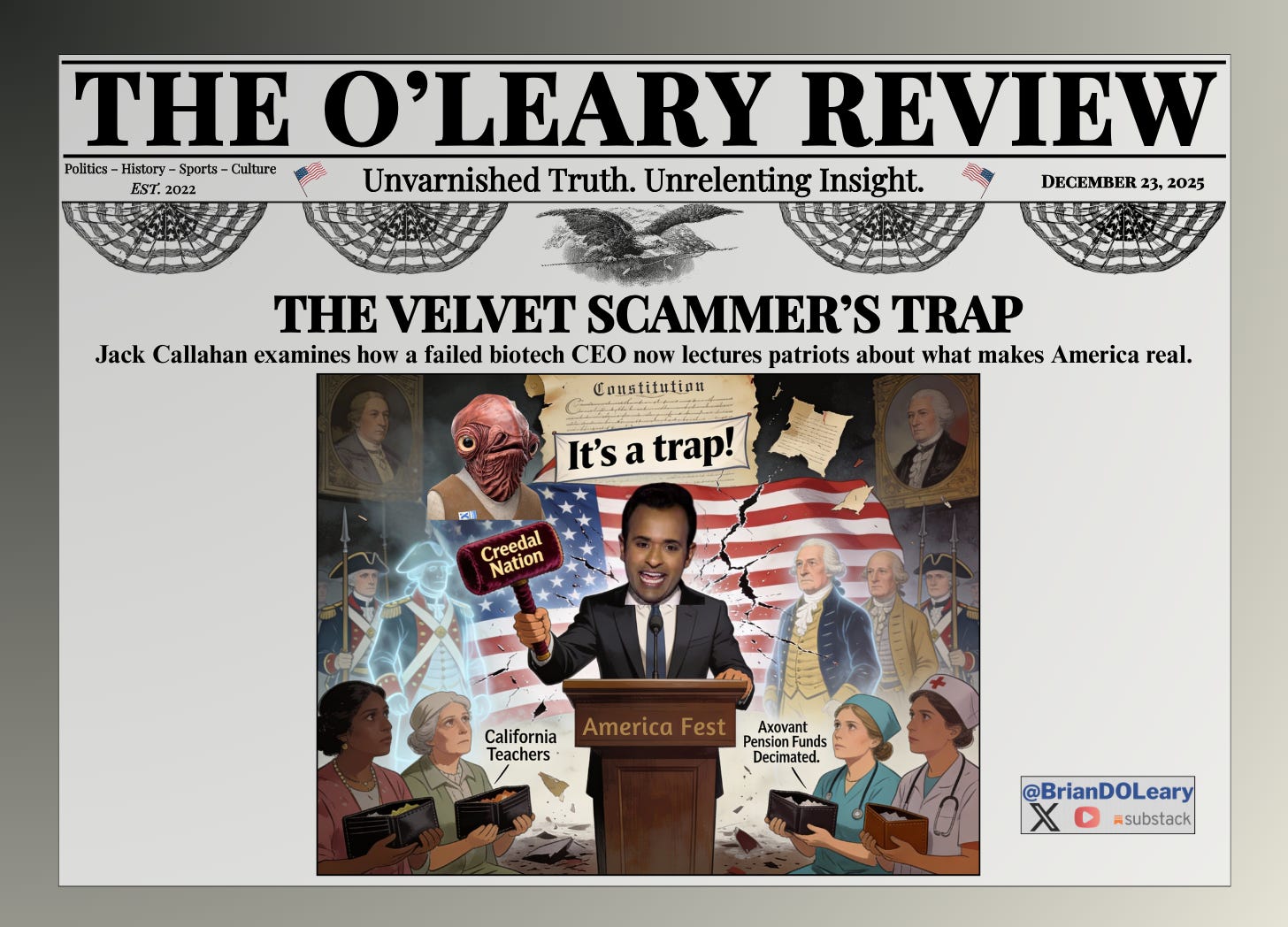
“Vis-à-Vis Obamaswamy—a mirror image of Barack, same ideology, different accent—stands up and tells you and me that we don’t get to say what America is,” Jack said, leaning back in his chair. “That a ‘heritage American’ is ‘un-American at its core.’ That to be American is binary: you either believe in the founding ideals or you don’t.”
“What this Soros-bred apparatchik is selling,” Jack continued, “is the same neoliberal Straussian garbage that Bill Kristol and David Brooks have been hawking for thirty-plus years. It’s the idea that America is just a creed—abstract principles—not a people, not a place, not a tradition. Not language. Not literature. Not the accumulated wisdom of our fathers and grandfathers.”
Jack pulled up the transcript. Ramaswamy’s words: “Our strength is that which binds us together… It’s not our lineage.”
“There it is,” Jack said. “He’s literally saying your heritage—your ancestors—don’t matter. Adams, Jefferson, and Franklin were wrong about what holds a nation together. And here’s the kicker: if you believe otherwise, he says you’re ‘loony.’ You’re on par with the woke left. You’re un-American.”
“But that’s not America,” Jack said flatly. “That’s not what the Founders built. Read John Adams. John Jay. Madison. They taught us that a nation is a people bound by a common history, language, culture, and faith—not by a loyalty oath to an abstract principle.”
“This guy—The Velvet Scammer—now tries to position himself as the moral arbiter of the conservative movement? He’s lecturing us about bigotry. About hatred. About who belongs?”
The irony could choke a horse.
“Brian, remind me: How much money did investors lose in Axovant?”
Billions. The drug failed Phase 3 trials in 2017, after Ramaswamy had already cashed out $37 to $40 million in personal capital gains. The California State Teachers’ Retirement System was decimated. Retail investors lost everything.
And Ramaswamy? He claimed “no regrets.” Called destroying pension funds a “learning experience.”
“That’s a con artist,” Jack said. “A fraudster who bilked pension funds and working people, then walked away rich. Now he’s trying to bilk Ohio—trying to bilk America—out of something infinitely more valuable: our heritage, our identity, our sense of who we are as a people.”
He tapped the desk. “You want to know what moral bankruptcy looks like? It’s a man who had no compunction destroying the life savings of nurses and teachers, now lecturing patriots about the immorality of caring about their ancestors.”
“There’s also this matter,” Jack said carefully, “that people are nervous to discuss. He was born in Ohio. But his parents were Indian nationals. Is he even a citizen? And if he is, on what grounds?”
The question hung in the air.
“Look, citizenship and the American character are two different things. Citizenship is a legal status—something you get by birth or naturalization. American birthright is something passed down through generations. It’s the choices, sacrifices, and devotions that your forebears made to build this nation.”
Jack leaned forward. “You can have citizenship and still be a stranger. You can hold a passport and still be a foreigner to the thing that makes America, America.”
Ramaswamy, for all his Harvard polish and boardroom credentials, is a citizen by paperwork. Not by tradition. Not by inheritance. Not by the understanding of what it means to be heir to the American experiment.
“There’s also the matter of his faith,” Jack said, his tone shifting. “Hinduism in the American public square? I’m not saying he should hide it. I’m saying we need an honest conversation about what that means.”
John Adams understood. The Founders understood. A republic cannot survive when the majority loses the shared moral framework rooted in Christian civilization and classical virtue, giving way to radical pluralism in which every citizen is a blank slate.
“You can have individual Hindu Americans,” Jack said. “That’s fine. But you cannot have a nation where Hinduism—or Islam, or Buddhism—shapes the public square the way Christianity has. Not without losing the coherence of the thing itself.”
Ramaswamy isn’t being rejected because he’s Indian. He’s being rejected because what he represents is corrosive to the thing that made America possible.
“Ramaswamy gets up at the podium and tells young conservatives that caring about your heritage is ‘loony,’” Jack said, pulling the threads together. “That a man whose ancestors fought in the Revolution has no more claim to America than a man whose parents arrived yesterday. That the only thing that binds us is a belief in meritocracy, the Constitution, the ‘founding ideals of 1776.’”
“But here’s the trap, Brian, and ol’ Admiral Ackbar was right: It’s a trap!” Jack said. “The moment you accept that definition of America, you’ve already lost. You’ve ceded the nation to people who have no stake in its survival, no investment in its continuity, and no understanding of what made it work in the first place.”
“Ramaswamy isn’t building anything. He’s tearing down the only thing that has ever held Americans together: the understanding that we are a people, with a history, with traditions, with a culture worth preserving precisely because it works.”
Jack set down his coffee. “He offers the same con. Once, it was with fake drugs. Now it’s with a fake nation. He promises an America without Americans: a people without a past.”
“It’s another scam, Brian. This time, he’s not stealing money. He’s stealing identity and heritage. He’s stealing the very thing that makes resistance to the woke left even possible.”
The man in the expensive suit, speaking beautiful words about tolerance and meritocracy, has already proven he has no qualms about destroying the life’s work of people who trusted him.
Why should patriots trust him with something far more valuable—the soul of America itself?