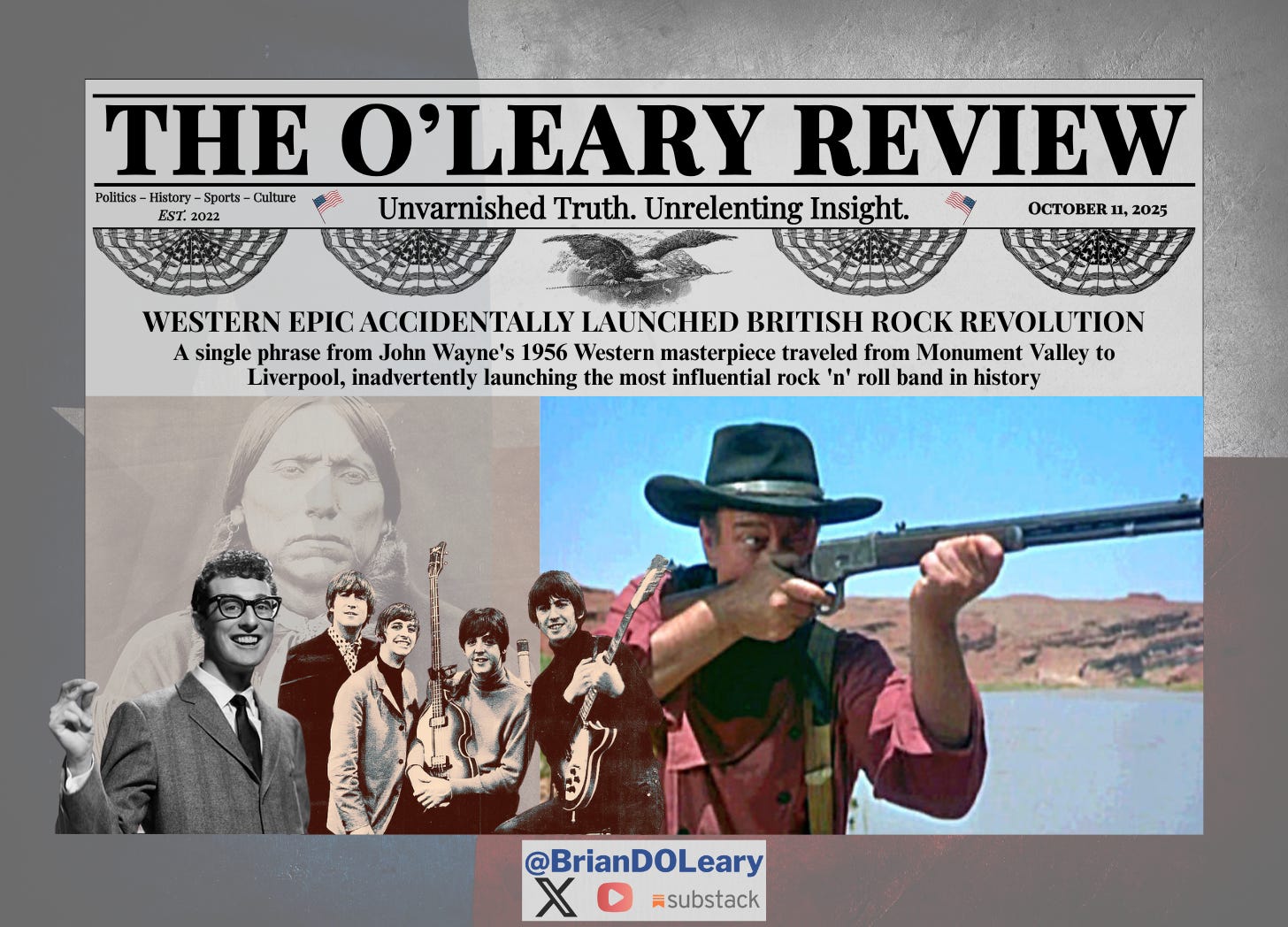
A single phrase from John Wayne’s 1956 Western masterpiece traveled from Monument Valley to Liverpool, inadvertently launching the most influential rock ‘n’ roll band in history
In 2008, the American Film Institute (AFI) named The Searchers (1956), starring John Wayne and directed by John Ford, the greatest American Western. It also ranks 12th on AFI’s list of the 100 greatest movies of all time. Many consider this John Wayne’s best acting performance. Film critic Roger Ebert said Wayne’s Ethan Edwards was “one of the most compelling characters Ford and Wayne ever created.”
Shot with 35mm film stock, using the relatively new VistaVision process, the landscape scenes are remarkable. Though set in the Llano Estacado of Texas and New Mexico—in the heart of Comanche territory, or “Comancheria” —the motion picture was primarily filmed in Arizona and Utah’s Monument Valley.
Ford’s style influenced a generation of filmmaking, particularly David Lean’s Lawrence of Arabia (1962). Several scenes from this film also informed George Lucas’s cinematography in the first Star Wars film (1977) and in other key scenes throughout the franchise.
During principal photography of The Searchers, Ford requested that a first-of-its-kind “making of” documentary be produced. The studio granted his request and, eventually, the finished program aired on television as a four-part feature of Warner Bros. Presents, essentially serving as a promotional vehicle for the movie.
For nearly 70 years, The Searchers has had its share of critics. To be fair to Ford, Wayne, et al., the tender 21st-century populace was not the intended audience for this film. The modern American—fearful of tackling complex moral issues and one who dismisses such topics out of hand as “racist” or something equally ludicrous—may have a hard time watching the film.
Reflect. When we are introduced to Ethan Edwards, we find that he is … gasp! … an ex-Confederate soldier. In 1868—three years after the War’s end—he returns to his brother’s ranch in West Texas after several years away, having served in the CSA Army and, later, as a mercenary in Mexico.
Soon after Ethan’s arrival, a neighbor’s cattle are stolen. Ethan joins a few other men and sets out to recover the cattle, but finds, when they return home, that a band of Comanches torched the Edwards ranch and home. Ethan’s brother, Aaron, and Aaron’s wife and son are found dead. The Comanche abducted Aaron’s two girls.
Ethan then puts together a search party to pursue the raiders. He soon finds the body of his eldest niece, brutally murdered near the Comanche hideout.
The men eventually lose the trail of the Indians. But a few years later, they get word that the now 15-year-old Debbie, Ethan’s long-lost younger niece, was not only alive, but now one of the wives in the harem of “Scar,” a Comanche chief.
When they reach Debbie, who is now older and portrayed by Natalie Wood, she says she wants to remain with the Comanche. Uncle Ethan is not pleased with her decision, to say the least.
The film then continues to its dramatic conclusion.
Wayne’s catchphrase in the film, “that’ll be the day…” also inspired a couple of young theatregoers in Lubbock, Texas—a principal modern city of the Llano Estacado—to go home and write a rock ‘n’ roll song.
Jerry Allison and bandmate Charles Hardin Holley penned the track, and they first recorded it in July 1956 in Nashville. This version never charted, despite Holley’s budding stardom at the time.
Holley, Allison, and their new band re-cut the track in 1957 in Norman Petty’s studio in Clovis, New Mexico, about 100 miles from Lubbock. This single from “The Crickets” soon rose to the top of the charts as bandleader Holley was becoming a superstar in his own right.
Three days before “That’ll Be the Day” topped the charts, a sister label released “Peggy Sue” and “Everyday,” both tunes by the Crickets, though credited to their bandleader’s solo act, “Buddy Holly.” All these records soon rocketed up the charts.
Holly’s music became influential not only in contemporary culture but also in the history of rock ‘n’ roll. Over in Liverpool, England, The Quarrymen—a quintet that included future Beatles John, Paul, and George—cut their first demo recording in 1958. It was “That’ll Be the Day.”
From there, things started to fall into place for the Liverpudlians.
So it goes: If it weren’t for Texas, we’d have no Beatles. As an adaptation of an Alan Le May novel of the same name, published in 1954, the movie’s main plot was indeed set in the southern plains of what is now mostly Texas.
The surviving notes from Le May’s research suggest that the plot was loosely based on Brit Johnson, a man who had ransomed his wife and children from the Comanche in 1865 and then made his life’s mission to search for other Americans kidnapped by Indians. Johnson, an African-American and a teamster by trade, was later killed by the Kiowa in a 1871 searching mission.
Amongst the 64 real-life cases of 19th-century Texas child abductions Le May studied, perhaps the most famous story was that of Cynthia Ann Parker. This bizarre tale is also explored in great detail in S.C. Gwynne’s 2011 book, Empire of the Summer Moon: Quanah Parker and the Rise and Fall of the Comanches, the Most Powerful Indian Tribe in American History.
In 1836, a Comanche raid of Fort Parker, Texas, resulted in the kidnapping of nine-year-old Cynthia Ann from her family home. The Comanche killed five men in the raid, while also capturing two women and two other children.
The ages of the children, Cynthia Ann and the fictional Debbie, were about the same. Nothing much else is.
Parker was with the Comanche for 24 years until a band of Texas Rangers found her and returned her to surviving Texian relatives near modern-day Dallas. By that time, Cynthia Ann was married to a Comanche chief and had three children, one of whom—Quanah—is considered the “last Comanche chief.”
Cynthia Ann did not want to return to “America,” but when she did, she was allowed to bring her daughter, Prairie Flower. She was forced to leave her two sons behind. Tragically, a few years after Cynthia Ann returned to her birth relatives, young Prairie Flower died of pneumonia.
Cynthia Ann Parker eventually died at the relatively young age of 43, reportedly as a sad, grief-stricken woman.
Meanwhile, Quanah Parker continued to give the Union Army fits for many years, though his Comanche band had dwindled to approximately 25,000 people with only about 6,000 warriors. After the Army and its buffalo hunters killed off most of the Comanche food source—the plains bison—Quanah’s band finally surrendered in 1875.
Ultimately, he cooperated with the U.S. government, helping to settle the Kiowa-Comanche-Apache Reservation in what is now southwestern Oklahoma. Later, Quanah became wealthy by ranching cattle and even had bit parts in some early Hollywood Westerns.
Gwynne writes:
Quanah also had a curious and noteworthy friendship with Teddy Roosevelt. In March 1905 he rode in an open car in Roosevelt’s inaugural parade in buckskins and warbonnet, accompanied by Geronimo, two Sioux chiefs, and a Blackfeet chief. … A month later, Roosevelt traveled west on a special train to participate in a much publicized “wolf hunt” on lands belonging to the Comanches, Apaches, and Kiowas in southwestern Oklahoma.
Comancheria was vast, and for centuries, its native horsemen, relying upon Stone Age technology, gave no quarter to the Spanish, Mexican, Texian, or American settlers. Furthermore, the Comanches were no friends to other neighboring Indian bands or tribes, either. Comanche tactics included massacres, enslavement, and pillaging, and were not uncommon.
Importantly, it was the Comanche presence that single-handedly halted westward expansion in the Southern Plains from the 1830s to the mid-1870s. To reach the West Coast, one had to take either a northern overland route or sail around Cape Horn. This is how California, having entered the Union in 1850, was settled well before the Texas frontier was closed.
Nevertheless, if the brutality and wars between Comanches and Texians had not occurred, John Wayne could never have uttered his famous line.
Thus, the Crickets would never have charted that first hit record. If so, the Beatles would likely never have formed, perhaps leaving their future members forever mired in obscurity and irrelevance.
So, if not for Texas, pop culture would be dramatically different today.